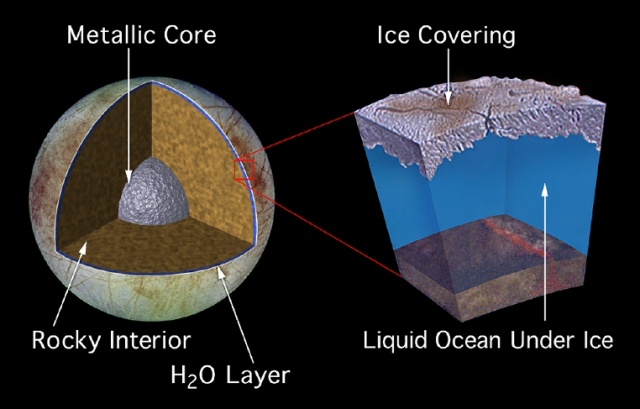
We’ve all heard about the potential of life on Mars, but did you know that there could possibly be life in the outer solar system as well? In general, the outer solar system has such low temperatures that finding surface liquid water is quite unlikely. However, certain places, such as some of Jupiter’s moons, have lakes or oceans full of liquid water below their surface. Three of Jupiter’s moons: Europa, Ganymede, and Callisto, all have subsurface oceans. Out of these, Europa is the most likely to be somewhat inhabitable. Scientists believe that the ice and rock that created Europa has all of the ingredients that are necessary for life. Furthermore, Europa has strong internal heating due to tidal heating. While Europa seems like it could potentially have everything needed for life to originate, sunlight cannot cause photosynthesis in a subsurface ocean. Since it has much fewer energy sources for life, any life that exists there would probably be primitive and microscopic. However, if it did have proper energy sources, since its ocean is so large, the creatures that could live there could be much larger than us. This is all speculation with what little data we have about this moon, but scientists are hoping to one day send a robotic submarine that could melt through the multiple kilometers of ice and into the ocean below.
The planets in our solar system can be divided into two categories: jovian planets and terrestrial planets. Jovian planets consist of those with larger masses and are also made up mostly of hydrogen and helium gas. This includes the planets of Jupiter, Saturn, Uranus, and Neptune. These planets are like Earth in that moons orbit them, but unlike Earth, there are more than 170 known moons that orbit the jovian planets. Jupiter and Saturn each have 60 moons orbiting them. The most interesting of these moons are the four Galilean moons that orbit Jupiter: Io, Europa, Ganymede, and Callisto. Io is the most volcanically active world in the solar system. Tidal heating, meaning the effect of Jupiter’s tidal forces, are what keep Io so hot inside. Europa, on the other hand, is covered with water ice. Scientists believe that a large ocean lies beneath the icy exterior. Ganymede is the largest moon in the solar system, and its surface is also made of water ice. Callisto, the outermost Galilean moon, looks like “a heavily cratered iceball” and has many impact craters. I was fascinated by learning about these moons because they are so different from the moon that orbits Earth. I wonder if anything would change in our lives on Earth if our moon had different characteristics, such as having ice water for its surface or massive volcanoes.
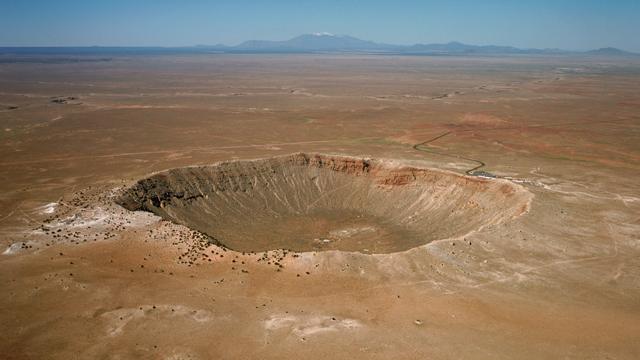
We know that asteroids and comets exist, but where do they come from? In chapter 8, I learned that asteroids and comets are formed from the “leftovers” of planet formation. Asteroids are the rocky leftovers of small planets in the inner solar system, whereas comets are the icy leftovers of small planets in the outer solar system. Scientists have evidence of these conclusions from meteorite analysis, along with visits on spacecrafts. There was even a theory called the nebular theory which predicted that comets existed in the Kuiper belt long before anyone discovered the comets. The asteroids and comets that are left in our solar system are only a small percentage of the total number that has existed throughout the universe. The others have either gone into deep space due to gravity, while others have collided with planets and left behind impact craters. An example of an impact crater is that people speculate that the extinction of dinosaurs occurred because an asteroid struck Earth. The majority of these collisions happened in the first couple of hundred million years of the solar system’s existence, which is now called the period of heavy bombardment. These impacts probably altered the universe in necessary ways that made life on Earth possible. Water was likely brought to Earth from impacts of water-being planetesimals, probably from the outer portion of the asteroid belt. I think this topic is very interesting because I would love to know more about what knowledge researchers have about the changes that occurred in the solar system due to different collisions, that eventually made our life possible. This also makes me think that there are probably other forms of life out in space because with the different collisions, I doubt that only one place was formed to be habitable.
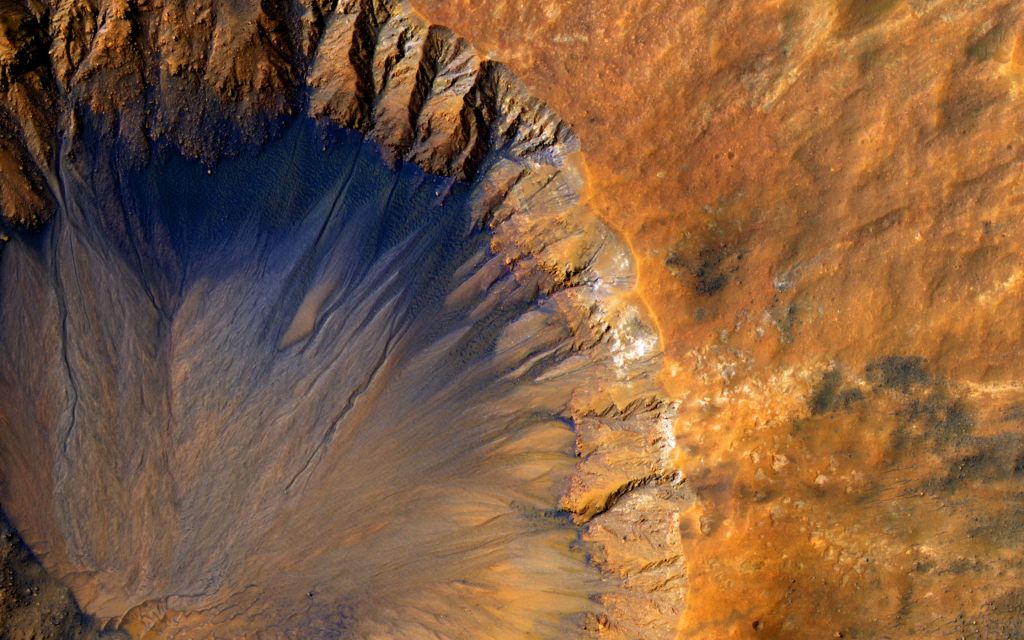
I liked reading the section of the book that talked about how we know that there was water on Mars. I’ve always heard this fact about Mars being livable because it has water, but didn’t think about how they figured that out. I learned that there are actually no bodies on water on Mars today because the surface conditions would not allow that. Any bodies of water would turn into ice because of Mars’ temperature or into gaseous form because of the low air pressure. However, there is evidence of water erosion which shows that Mars must have used to have a much warmer climate and higher atmospheric pressure. They believe that water has not been on Mars for about 3 billion years.
When the rovers “Spirit”, “Opportunity”, and “Curiosity” landed on Mars, they captured lots of photo evidence that proved the existence of water on Mars at one point in time. “Opportunity” found tiny spheres composed of the minerals hematite and jarosite, which both form in salty, acidic water. “Curiosity” found that the dried clay and sedimentary rocks at the lower elevations on Mars show that there was pure water there. The chemical analysis of the rocks showed that they are made up of minerals that form in pure water, like lakes on Earth. Based on the data from these rovers, scientists were able to conclude that there was a vast lake at Gale Crater and it dried out 3 billion years ago. The older layers of rock were formed when the water was quite pure, and the newer and higher layers of rock formed as the water became more acidic and began to dry up.
I enjoyed learning about this topic and it made me wonder if Mars will ever evolve back into a warmer climate with higher atmospheric pressure and be able to have flowing water again, especially in case we ever need to move to Mars.
My favorite part of this unit was learning about the developments throughout history made in the field of astronomy. I had heard of famous names such as Copernicus, Tycho Brahe, Kepler, and Galileo, but had not really learned about them to understand what their contributions were. I learned throughout this unit that around Copernicus’ time, people had begun to notice that the Ptolemaic model was inaccurate, but no one was willing to take on the challenging calculations required to improve the model. Copernicus was brave enough to give it a try. He built upon Aristarchus’s Sun-centered proposition of the solar system, and discovered that it provided a much simpler explanation for retrograde motion. He took the model a step further by calculating the orbital period of each planet and its relative distance from the Sun. Something that amazed me was that Copernicus was conflicted about whether or not to publish his findings in fear that they would be seen as crazy, but eventually decided to. He published his first copy of his book on the same day he died. If he had died a day earlier, his findings may not have been put out into the world, and maybe we would have had to wait many more years for someone to find out that the solar system is heliocentric.
Tycho Brahe apparently lost part of his nose in a sword fight against a fellow student to determine who was the better mathematician. That didn’t stop him from discovering ground-breaking new observations from the naked-eye. He designed himself a new nose made of silver and gold, and went on his way! He is most famous for discovering a nova, meaning “new star.” I was fascinated to find out that Johannes Kepler was actually Brahe’s apprentice! He continued Brahe’s work and came up with the laws of motion. His biggest discovery was that the planets orbit in ellipses, not circles. His laws matched Brahe’s data, while also providing evidence in favor of Copernican heliocentrism. Galileo came along after these fellas and answered any remaining doubts people had about the universe. Some of his most important data was about stellar parallax, which was an idea unheard of at the time. Galileo’s belief in these new ideas was not well accepted at his time. The Catholic Church believed that the Earth was at the center of the universe, and ordered Galileo to go in front of the Church inquisition in Rome and take back his comments that the Earth orbited the Sun. However, it is said that as he agreed with the church, he whispered under his breath, “And yet it moves” in Italian.
Learning about these people was very interesting because I learned about more than just their discoveries, but also their lives. I didn’t know that Copernicus only published his work the day he died, or that Brahe lost part of his nose, or that Kepler was Brahe’s assistant and they had a very strained relationship. It was cool to see these people as regular human beings, and not just crazy smart people with crazy cool discoveries. All of their discoveries required courage, patience, and persistence, and it is inspiring to hear about how they took on the hard challenges that no one else wanted to face.
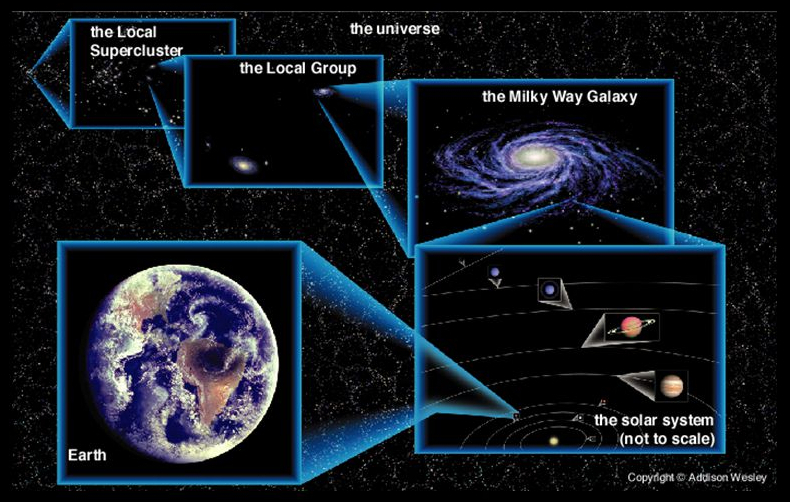
Something that I loved learning about in this unit was putting the size of the earth in perspective. That is the main reason why I am fascinated by space- because the more we know about it, the more we realize how little we actually know and how small we are in the grand scheme of things. I learned that in order to try and fit all that we know about the solar system in a diagram to attempt to visualize the galaxy, we have to reduce the scale to a factor of 1 to 1019. Our entire solar system, which Earth is only a small part of, is represented on that diagram merely by a dot. That is crazy small!! There are other ways to measure the vast size of the galaxy as well, such as using stars. There are more than 100 billion stars in the galaxy. If you counted one star per second, it would take you 3000 years to count all of the stars! Furthermore, in terms of the solar system, the Milky Way galaxy that we live in is merely one of 100 billion large galaxies, not even including the many more small galaxies. That would mean that there would be approximately 1022 stars in the universe, which is like the amount of grains of sand on all of the beaches combined.
Putting ourselves into perspective like this is eye-opening. We get stressed by the things we have to complete in our day to day lives, always thinking that if we do something wrong, it will “be the end of the world.” However, as we can see how tiny we are, we can begin to understand how the world truly does not revolve around us. As this perspective can make some people feel like they can’t make a difference, I think it helps reduce feelings of pressure and stress and emphasizes that our lives are minuscule, so we might as well use our time to do something meaningful.



 Mira's Blog